

Texas Rising is not just a phrase for a camera crew or a promotional arc around Texas men’s basketball. It is the daily work behind the doors: practice habits, roster choices, staff alignment, and the pressure that comes with trying to make Austin feel like a true college basketball center. Sean Miller’s preparation matters because Texas basketball is not being built in the abstract. It is being built in front of families, high school coaches, former players, and a city that has learned to expect more from Moody Center.
Miller arrived at Texas with a clear public record. He was hired on March 24, 2025, as the 27th head coach in Texas men’s basketball history. That same day, the Texas Board of Regents approved a six-year, $32 million contract that started at $4.8 million for the 2025-26 season and included $200,000 annual increases through 2030-31, according to AP’s report on the contract. That kind of commitment does more than set a salary. It sets a public bar for what preparation must look like.
Texas Rising Starts With The Practice Standard
Texas Rising And The First Rep After March
The public record does not give us Miller’s full practice scripts, and that matters. Behind-the-scenes stories can get loose fast if they are built on rumor instead of verified detail. What we can say is that the results of his first Texas season gave a clear picture of his coaching priorities: pace, shot quality, offensive spacing, and enough toughness to survive a league he called one of the deepest he had coached in.
In 2025-26, Miller’s first Texas team finished 21-15 with a 9-9 SEC record. The Longhorns reached the NCAA Tournament Sweet Sixteen after wins in the First Four, Round of 64, and Round of 32. Their run ended against Purdue, 79-77. That two-point loss was painful, but as a coach, I see the teaching film as much as the heartbreak. A team that survives three NCAA Tournament steps has learned something about late-clock execution, travel strain, short prep windows, and emotional recovery.
Why The Contract Raised The Temperature
A long contract can buy time, but it does not buy patience from a basketball community that has seen flashes of national relevance and wants staying power. The dollar figure told Austin that the university expected Texas basketball to act like a top-tier program every day. That pressure reaches the practice floor. It changes how players respond to a scouting report. It changes how staff members grade effort. It changes how a newcomer learns that the standard is not a slogan.
That is where coaching becomes cultural work. In Texas, the best programs connect college basketball to the youth gyms, private trainers, school coaches, and families who watch every possession with a trained eye. Miller’s preparation sits inside that larger local web. A missed box-out at Moody Center becomes a teaching clip for a middle school coach in Round Rock. A freshman guard’s footwork becomes a talking point in summer workouts across the state.
What Miller’s First Texas Season Revealed
Sweet Sixteen Pace Became A Teaching Tool
Texas averaged 82.8 points per game during that 2025-26 season and shot 48.4% from the field. The field goal percentage was the program’s highest since 1988-89, and the scoring average marked the first time Texas had cleared 80 points per game since 2009-10. Those numbers say something about preparation. They suggest a team drilled to play with pace without turning pace into carelessness.
The efficiency profile backed that up. Texas ranked 13th nationally in offensive efficiency per KenPom with a 124.9 mark. I do not read that as a spreadsheet brag. I read it as evidence of repeated habits: early offense, spacing discipline, paint touches, and players understanding where the next shot should come from. Coaches talk about freedom, but real offensive freedom is earned through structure.
Swain’s All-Around Season Set The Bar
Dailyn Swain gave Miller’s first Texas team a rare kind of production. He led the Longhorns in scoring at 17.3 points per game, rebounding at 7.5 per game, assists with 129, steals with 59, and minutes at 32.8 per game. He was the only player in a major conference to lead his team in all five categories, then went No. 15 in the 2026 NBA Draft.
For young Texas players watching from Dallas, Houston, San Antonio, the Valley, East Texas, or the Panhandle, that kind of season carries a message. Development is not always a straight line toward one role. Sometimes the best player is the one trusted to fill five needs. That is a coaching lesson with Texas roots: help your team in every column, then let the recognition follow.
Roster Construction And The Austin Pipeline
Texas Rising Freshmen And Transfers
The next layer of Miller’s preparation came through roster construction. His first offseason at Texas, in spring and summer 2026, featured 11 newcomers. The combined freshman and transfer class ranked No. 1 nationally by 247Sports, while the pure freshman class ranked No. 4 and was led by three in-state Texas players.
That mix says a lot about modern college basketball. A staff cannot just recruit talent. It has to recruit fit, maturity, practice temperament, and role acceptance. Transfers may bring production, but they also bring habits from other programs. Freshmen may bring upside, but they need daily teaching. The coach’s job is to make those timelines meet before the schedule exposes the gaps.
Why In-State Players Matter
For Texas Rising, the in-state piece is more than a recruiting note. It is a connection to the state’s basketball identity. Texas has always had distinct basketball personalities: Houston guards who play with force, Dallas-area wings with polish, San Antonio players raised on spacing and poise, border-town players who understand toughness, and small-town kids who learn to compete because every game is personal.
When Texas signs in-state talent, it sends a signal to high school gyms that the flagship program is paying attention. That matters to the local sports economy, too. Families travel. Coaches visit. Younger players study warmups. The college program becomes a mirror for the state’s player development system. Our earlier piece on Austin hoops engagement tracks that same connection between roster change and community interest.
SEC Pressure And Local Basketball Identity
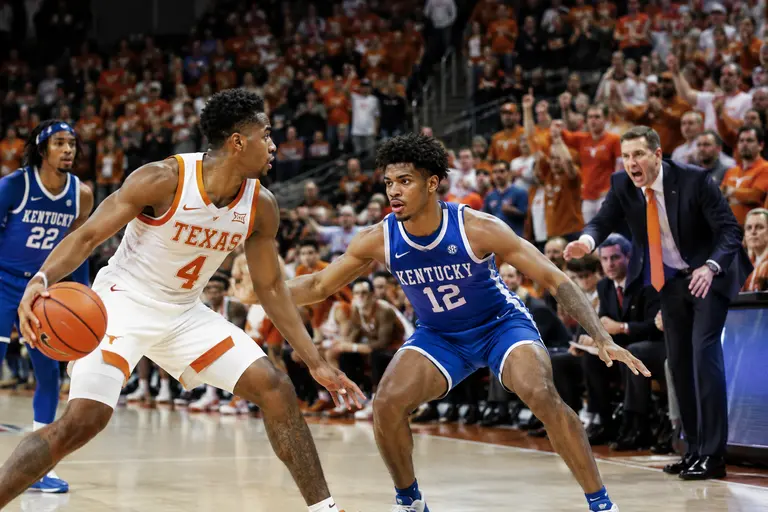
Miller’s SEC View Carried Weight
Miller did not soften his view of the SEC after one trip through it. As Texas entered its first SEC Tournament under him, he said the 2025-26 SEC was “as challenging as any I’ve ever been a part of,” according to Yahoo Sports’ SEC Tournament report. That statement matters because Miller had coached in major college environments before arriving in Austin.
For Texas, SEC basketball pressure is not just about tougher scouting reports. It is about body recovery, frontcourt depth, late-season legs, and whether guards can make clean decisions after being bumped for 35 minutes. Coaches prepare for that with practice contact, film honesty, and lineup experiments that may not look pretty in November but pay off in March.
What Austin Learns From The Grind
Austin is still shaping its college basketball personality. Football will always cast a long shadow here, but Moody Center has given basketball a sharper local stage. Miller’s job is not only to win games. It is to make the city feel the work behind the result. That means a fan base learning to value a defensive rotation in January as much as a dunk in March.
Miller earned his 500th career win as a collegiate head coach on January 31, 2026, when Texas beat Oklahoma 79-69. NCAA records adjust his win total because of vacated wins from his Arizona tenure, but the moment still marked a long coaching arc. In a rivalry game, against a familiar regional opponent, it also fit the Texas basketball story: history, rivalry, and a crowd that understands what Oklahoma on the schedule means.
Why Texas Rising Matters Inside Moody Center
For Coaches, Families, And Players
The real behind-the-scenes value is not access for access’s sake. It is what coaches, families, and players can learn from how a program handles expectation. Miller began his second Texas season in 2026-27 with higher attention on the program. He has described that type of expectation as energizing and has spoken about key pieces being aligned for Texas to build toward title contention.
That does not guarantee a trophy. Texas basketball has taught us that nothing is owed, not by name, not by budget, not by recruiting rankings. The work still has to survive the next practice, the next travel week, the next cold shooting night, and the next young player learning how hard college basketball can be.
Texas Rising matters because it puts the preparation, not just the score, at the center of the story. For a Texas coach, that is the heart of it. The film room, the scout team, the extra free throws, the transfer learning a new defensive call, the freshman hearing hard truth after practice — those are the scenes that build a program. If Miller’s Texas tenure becomes what Austin hopes it can become, the roots will be found there, long before the final horn.