

Austin Goosby stepped into Texas basketball with two kinds of pressure already on his shoulders: the outside label of a national freshman guard and the local expectation that comes when a Texas-raised prospect stays close enough for family, former teammates, and youth coaches to keep watching every possession.
That is not a small thing in this state. A guard from Irving’s Dynamic Prep does not arrive at the Moody Center as a mystery. He arrives with gym stories already attached to his name, with coaches who have seen the habits behind the ranking, and with young players across North Texas measuring their own work against his next step.
On October 27, 2026, the Naismith Basketball Hall of Fame released the preseason watch list for the 2027 Jerry West Shooting Guard of the Year Award, naming Goosby as one of 20 candidates for the honor watch list release. The award recognizes the top NCAA Division I men’s shooting guard, and the list was scheduled to be cut to 10 players in February 2027 and five finalists in March 2027.
Then came the basketball. On November 2, 2026, Texas beat Chicago State 109-59 at the Moody Center, the Longhorns’ highest-scoring season opener since 1992 season-opening win. Goosby’s debut line did not read like empty window dressing: 27 minutes, 7 points, 7 rebounds, 8 assists, 2 turnovers, 2-of-5 shooting, 1-of-3 from three, and 2-of-2 at the foul line.
Why Austin Goosby Watch List Talk Matters
Austin Goosby And The Watch List Signal
A watch list is not an award. Coaches know that better than anyone. It is a marker, a public notice that a player’s skill set has earned attention before the long grind of conference play, scouting reports, travel, and shooting nights that do not always cooperate.
For Austin Goosby, the Jerry West Award watch list said something specific: people outside Texas already saw him as a shooting guard worth tracking. Inside Texas, the meaning ran deeper. It tied a Longhorn freshman to a development trail that began before college practices, before media day labels, and before the first Moody Center box score.
The list also places a freshman in the same conversation as older guards who have already learned the physical side of the college game. That does not guarantee production. It does raise the standard for film sessions, defensive assignments, shot selection, and how a young guard responds when the ball changes sides and the game gets tougher.
What Coaches See Before The Box Score
Coaches do not watch a freshman guard only for points. They watch whether he catches cleanly, whether he makes the simple advance pass, whether he talks on defense, whether he can play through a missed jumper without carrying it into the next possession. A watch list name can pull eyes toward a player, but those details decide how long he stays on the floor.
Goosby’s opening-night 8 assists mattered because they pointed to more than a scoring reputation. His 7 rebounds mattered because guard rebounding travels well from one level to another. His 2 turnovers in 27 minutes gave coaches a starting point for teaching, not a warning flare. In early November 2026, those numbers were not a full profile, but they were enough to show why his minutes were meaningful.
From Dynamic Prep To Moody Center
The Irving Development Thread
Goosby arrived at Texas from Dynamic Prep in Irving, where his senior season in 2025-26 included averages of 16.2 points, 4.8 rebounds, 2.9 assists, and 1.5 steals per game. His team went 39-5 and reached the Chipotle Nationals semifinals. Those numbers belong in the story because they show a guard who was asked to produce inside a winning environment, not just collect points in isolation.
That matters for Texas coaches and Texas communities. The state’s best high-school and prep programs have become teaching hubs where guards learn pace, spacing, film habits, and how to handle the ball against length. Dynamic Prep’s place in Irving gave local players another visible bridge from Texas gyms to the college game.
For readers following the local pipeline, this fits with the broader freshman guard story around the program, including our earlier piece on Texas freshman guard rise. The reason it matters is not recruiting noise. It is the coaching chain: youth trainers, prep coaches, college assistants, and head coaches all touching the same player’s habits at different stages.
Freshman Minutes With Real Responsibility
In that opener, Austin Goosby did not simply check in late and run out the clock. He played 27 minutes and handled enough possessions to finish with a game-high 8 assists. He also pulled down 7 rebounds, a game high for him through the first game and a sign that Texas could use his size and activity in more than one phase.
Over his first two games of the 2026-27 season, Goosby totaled 18 points, 11 rebounds, 11 assists, and two made three-pointers while earning a starting role and significant playing time. That is still a tiny sample. Any coach worth listening to would say the same. But early trust is not accidental. Freshmen earn minutes through practice habits, defensive buy-in, and decision-making under speed.
- Scoring base: His high-school production showed he could carry offense without being limited to one shot type.
- Passing value: His 8 assists in the debut gave Texas another connector on the floor.
- Rebounding edge: His 7 boards from the guard spot gave the Longhorns extra possession value.
- Recognition pressure: The Jerry West watch list put his name in a national guard conversation before November games began.
The Coaching Value In A Freshman Guard
Teaching A Guard Who Already Has A Name
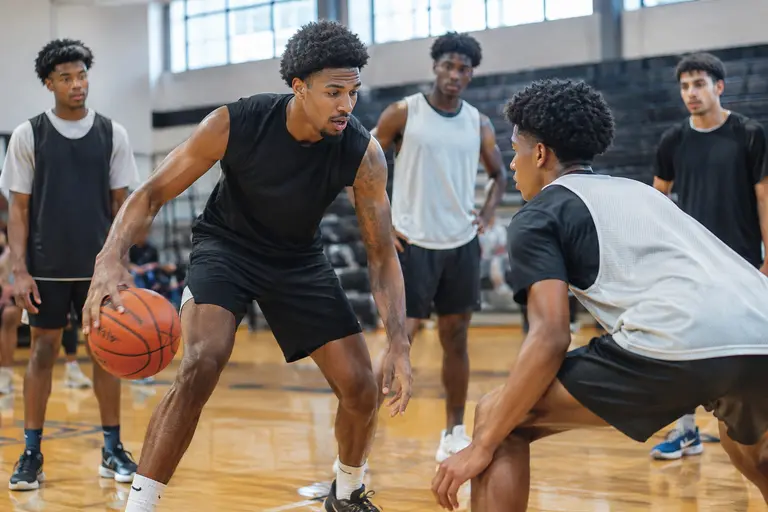
One of the hardest jobs in coaching is taking a player who has already been praised and getting him to love correction. That is where a freshman season often becomes a test of character. The watch list is public. The film room is private. The best development happens when the public label does not get louder than the daily teaching.
Austin Goosby is the kind of freshman who gives a staff different teaching lanes. If he handles the ball, coaches can grade tempo and reads. If he plays off the ball, they can grade relocation, spacing, and shot readiness. If he guards bigger wings or quicker guards, they can learn what matchups fit him now and what matchups will require strength and reps.
For Texas basketball people, this is where the story becomes less about a nomination and more about craft. A young guard’s best nights can be exciting, but his steady possessions build trust. A quiet closeout, a hard block-out, a pass made one beat early — those plays rarely lead a national write-up, yet they decide rotation roles.
Why The Local Gym Still Matters
Texas has always valued guards who carry themselves with neighborhood accountability. In smaller towns, that means seeing your coach at the grocery store. In bigger metro areas, it means walking back into a training gym where everyone remembers who defended you before the rankings arrived. Goosby’s move from Irving prep basketball to Texas keeps that accountability close.
The local angle matters because young players can point to a path that feels real. Dynamic Prep to Texas is not an abstract route. It is a Texas route. When a freshman guard earns national watch list attention and then contributes in a college opener, the next ninth-grader in a crowded gym sees the steps: skill work, strength, film, grades, competition, and coachability.
That is the piece I care about as a coach and historian. The award race will be decided later, after far more games. The community meaning begins sooner. It begins when a player’s rise gives local coaches one more example to use with the kid who thinks the details are optional.
What Austin Goosby Means For Texas Development
The fairest way to read November 2026 is with both pride and patience. Austin Goosby had already earned a spot on the Jerry West Award preseason watch list, made his college debut, filled several stat columns, and helped Texas open with a 109-59 win. Those are real markers. They are not the whole story.
The next stages were clearly defined by the award calendar: 10 players in February 2027, five finalists in March 2027. Between November 8, 2026, and those cuts, the real evaluation was set to happen in practices, scouting reports, road environments, and the grind that separates a talented freshman from a dependable college guard.
For Texas, the early signs gave coaches useful material. Goosby could pass, rebound from the guard spot, score without forcing a huge shot volume, and stay on the floor for a meaningful workload in his debut. For Irving and the wider Texas basketball community, his start gave another local development story a college stage.
That is why this watch list moment should be treated with care. Not as a coronation. Not as empty hype. It is a checkpoint in a player’s growth and a teaching tool for every Texas coach trying to show young guards what college responsibility looks like before the spotlight finds them.