

In the world of sports, Texas stands out with its Texas HS to NBA connection. It’s not just about Friday Night Lights. It’s about families moving for a chance at greatness in basketball. The numbers show a strong story.
Nearly 100 athletes will play in Super Bowl LX, and Texas leads with 15 players. The Dallas-Fort Worth area is key, with tough competition and deep talent.
Families seek stronger programs and more visibility. Who can blame them? Texas has a huge population, mild winters, and year-round training. Kids play basketball in December while others shovel snow.
The coaching here is top-notch, with many former college assistants. As the Texas to NBA pipeline grows, it brings stars like Cade Cunningham and Myles Turner. It’s a place where dreams meet opportunities. Are you ready to take the leap?
Pathways public private prep AAU and exposure event calendar
The Texas basketball scene is like a big chessboard. Players, coaches, and schools make moves all the time. Finding the right path can be like solving a maze, where every step could lead to success or failure.
Public schools like Duncanville and DeSoto are known for their pride and championships. But, the real excitement is in private and prep schools. Players move to top schools like Oak Hill Academy or Montverde Academy to get noticed by college scouts. It’s a risk, but many players find it worth it.
AAU showcases are the real battlegrounds for young basketball players. Events like the Nike EYBL, Adidas 3SSB, and Under Armour Association are more than games. They are where players show off their skills to college coaches. Missing out on events like Peach Jam or Las Vegas showcases can feel like vanishing.
The journey to get noticed is like playing Chutes and Ladders. One wrong move can send you back to the start, making you question your choices. The constant schedule of events means you must always be one step ahead, planning your moves carefully.
For players and parents, understanding these paths is key. It’s not just about being good at basketball. It’s about making smart choices in a game that never stops.
Academics and compliance GPA core courses testing NIL basics
Every aspiring athlete must navigate the academic maze. Core courses are not just suggestions; they are essential. Missing a single algebra credit can change a top recruit into a spectator. The NCAA Eligibility Center requires 16 core courses, a certain GPA, and good test scores.
In Texas, the UIL adds more complexity. High school athletes can earn from their fame, but they must be careful. Signing an autograph deal might be okay, but only if you follow the rules and get advice from a compliance officer.
Here’s the kicker: one semester of senioritis can ruin your Division I dreams. So, while your mixtape gets views, keep your transcript clean. Let’s look at the key points:
| Requirement | Description | Importance |
|---|---|---|
| Core Courses | 16 required courses, including math, science, and English | Essential for NCAA eligibility |
| GPA | Sliding scale based on test scores | Determines eligibility for scholarships |
| Standardized Tests | ACT or SAT scores needed | Critical for college admissions |
| NIL Compliance | Rules governing athlete endorsements | Protects amateur status |

In conclusion, the academic eligibility landscape is complex and challenging. But understanding these rules is vital to keep your athletic dreams alive. Stay informed, stay compliant, and keep your eyes on the prize!
What scouts track motor shooting size scheme fit film habits
Scouts don’t just watch the game; they analyze every play with great detail. They’re not cheering you on; they’re like detectives looking for clues. They’re not impressed by your three-pointers alone. They want to see how you move and if you play with passion.
Your motor is key. Do you run for every ball, or do you take it easy? Scouts notice your effort. Then, there’s your shooting. A slow release is a big problem. Your size is important too; being too small can be a disadvantage.
Scouts also look at how you fit into a team’s system. Can you run a pick-and-roll? Or are you just a show-off? They want to see if you can play a role in a team. Watching game footage is important, but they want to see if you study the game too.
The recruiting pathway is full of players with great stats but not the right skills. A scout once said, “I’d choose a player who sets screens over a tall guard who can’t defend.” It’s not just about numbers; it’s about how you play.
Season plan showcases camps rest windows and wellness
Navigating the high school basketball season is like walking a tightrope. It balances competition and recovery. Players often play in a whirlwind of games, showcases, and camps, leaving little time for rest.
It’s common to see young athletes limping into the school season after playing over 100 games in a summer. The aftermath? Shin splints and a thousand-yard stare.
A strategic season plan is essential. High school basketball runs from November to March. Then, AAU showcases from April to July follow. Elite camps in August and fall leagues soon after.
But when do players get to rest? The answer is often “never.” This leads to burnout rates that would make even a Wall Street intern blush.
Rest windows aren’t just a luxury; they’re a performance enhancer. Incorporating wellness into the mix is key. This includes sleep, nutrition, and mental health.
Some AAU coaches treat these elements like optional downloadable content. While skipping the Peach Jam to meditate might seem extreme, it’s wise to avoid playing in three different states within five days. Your body isn’t a rental car; you can’t just return it with an empty tank and expect no charges.
To thrive, young athletes must prioritize their well-being. The balance between rigorous training and necessary downtime is key to sustaining performance. After all, a well-rested player is a better player.
For more insights on the importance of AAU basketball in Texas, check out this article on why AAU basketball is the heart of Texas hoops.
Highlight reel dos and donts with sample outreach email
Making a highlight reel is like creating a movie. It’s your chance to show off your skills. Start with your defensive plays, off-ball movement, and passes that catch the eye. These are key for recruiters.
But, there are things to avoid. Don’t start with a 45-second intro that’s too flashy. And skip the Drake song that’s overplayed. Show off your all-around skills, not just dunking.
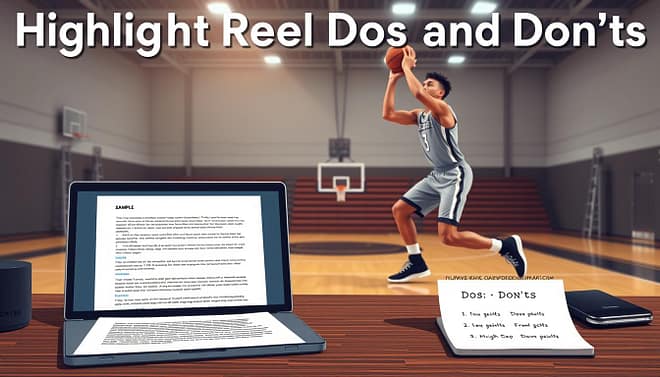
Your outreach email is your first impression. Here’s a sample that stands out: “Coach [Name], I’ve been following your program’s success with developing combo guards. My film is attached—I’d love to discuss how my defensive versatility could fit your system. Sincerely, [Your Name].” Keep it brief, specific, and professional. Avoid using casual phrases like, “Yo coach, check my mixtape, I’m the next LeBron.”
Also, use alumni lists from your school or AAU program. They can lead to valuable connections. But, approach them with respect, not entitlement. A little humility goes a long way.
| Highlight Reel Dos | Highlight Reel Don’ts |
|---|---|
| Lead with defensive plays | Include long intros with flashy graphics |
| Show off off-ball movement | Only feature dunks |
| Make passes that catch attention | Use overplayed music |
| Keep it concise and engaging | Be overly casual in outreach emails |
In summary, your highlight reel and outreach email are key to your recruitment journey. Get them right, and you’ll make a strong impression.
Mentorship find alumni leverage school resources and club coaches
Navigating basketball in Texas is like playing chess. Every move is critical, like in mentorship. The Texas basketball mafia is real, fueled by alumni networks from high school to the NBA. A call from a former player can turn a tryout into a scholarship. This shows the power of mentorship.
Start by exploring alumni lists. Your high school and AAU programs have them. Don’t just ask for favors; seek advice. These mentors have been where you are and can offer great insights.
School resources are often overlooked. Academic advisors, strength coaches, and even film teachers can help. They might assist with highlight reels or GPA advice. Use these resources well.
Club coaches are key too. They have many connections. But, treat them with respect. They can help you or ignore you. Remember, leveraging is part of the game.
Lastly, mentorship works both ways. You’ll be the one guiding others in the future.
| Type of Resource | Benefits | How to Leverage |
|---|---|---|
| Alumni Networks | Connections to colleges and pros | Reach out for advice and opportunities |
| School Resources | Academic and athletic support | Utilize advisors and coaches |
| Club Coaches | Networking and mentorship | Build a respectful relationship |

Budgeting travel strength nutrition recovery and medical costs
Let’s explore the financial side of the Texas to NBA pipeline. It’s not all about talent and dreams. Families face huge costs on their journey. These expenses can be overwhelming.
Imagine planning for flights to Las Vegas and hotels in South Carolina. You also need to budget for gas to every gym in Texas. And let’s not forget the $300 shoes that won’t last long. Strength training has become more complex, with specialized coaches and recovery tools like NormaTec boots. Nutrition plans are also a big expense, rivaling car payments.
Medical costs add to the financial burden. Ankle sprains, knee scopes, and physical therapy can quickly add up. The hidden costs of the pipeline are rarely talked about. If you’re not budgeting for these, you might be ignoring the reality.
The gap between the haves and have-nots is clear. For every Cade Cunningham, there are many who can’t afford to play. Here’s a look at some of the costs families might face:
| Expense Type | Estimated Cost | Frequency |
|---|---|---|
| Travel (flights, gas) | $1,500 | Seasonally |
| Strength Training | $2,000 | Annually |
| Nutrition Plans | $1,200 | Monthly |
| Medical Expenses | $1,000 | As needed |
| Equipment (shoes, gear) | $600 | Biannually |
In conclusion, making it from Texas to the NBA is not just about talent. It also requires smart financial planning. This journey demands careful budgeting to make every opportunity count. For more on the financial side of this journey, check out this resource.
Case mini studies Durant Ford Aldridge and recent pros
When you think of Texas high school basketball, names like LaMarcus Aldridge and T.J. Ford come to mind. They show the Texas HS to NBA journey. Each player took a unique path to success.
LaMarcus Aldridge played at Seagoville High School. His mid-range game was legendary. He then dominated at the University of Texas, becoming a seven-time NBA All-Star. His story is a classic tale of hard work paying off in a traditional public school setting.
T.J. Ford’s journey was marked by determination. The Willowridge High wizard was often seen as undersized. But he used his quickness to become a national player of the year and a lottery pick. His story resonates with many young athletes facing similar challenges.
Today, we see players like Cade Cunningham, who went from Arlington Bowie to the #1 overall pick in the NBA Draft. Cunningham’s path shows the ongoing strength of the DFW pipeline. Myles Turner and Jarrett Allen have also made names for themselves, proving Texas continues to produce top-tier talent.
Each player navigated the Texas pressure cooker, showing their talent and resilience. The following table highlights their high school achievements and subsequent NBA careers:
| Player | High School | College | NBA Achievements |
|---|---|---|---|
| LaMarcus Aldridge | Seagoville High School | University of Texas | 7-time All-Star |
| T.J. Ford | Willowridge High School | University of Texas | National Player of the Year |
| Cade Cunningham | Arlington Bowie | Oklahoma State University | #1 Overall Pick |
| Myles Turner | Euless Trinity | Texas | Defensive Player of the Year Nominee |
| Jarrett Allen | Round Rock High School | University of Texas | NBA All-Star |
These case studies highlight individual talent and the rich tapestry of the Texas HS to NBA pipeline. For more insights, check out this notebook on recent developments.
Family checklist timeline freshman to senior with deadlines
This roadmap is your guide through high school basketball. Freshman year focuses on grades. You need to pass core courses to be eligible.
Sophomore year brings AAU showcases. It’s a chance to get noticed but watch out for burnout. Start your NCAA Eligibility Center registration early.
Junior year is key. The recruiting window opens wide. Take unofficial visits, send your highlight reel, and go to camps where coaches can talk to you.
Senior year is about signing early. Finish your amateurism certification. Don’t let NIL deals distract you from your studies. Keep track of important deadlines like NCAA registration, SAT/ACT, and National Letter of Intent signing periods.
Missing deadlines can lead to appeals. The Texas to NBA path is tough. Stay organized and informed to stand out. Success comes to those who read and act on the details.