

The Texas Michigan rivalry is not a yearly feud, and that is exactly why it hits differently in Austin. Three football meetings across more than two decades gave Longhorn fans a rare measuring stick against one of college sports’ heaviest names. Texas won all three games, and each win fed a different kind of local pride: Rose Bowl belief, road-game muscle, and postseason staying power.
Texas Michigan rivalry And The Scoreboard Memory
Texas and Michigan have met three times in football, with Texas leading the series 3-0, according to StatMuse series data. That small sample is the whole point. Some rivalries are built by annual repetition. This one is built by scarcity. Each meeting arrived with a national frame, then left behind a story Texas fans could carry into tailgates, watch parties, recruiting debates, and barbershop arguments.
Texas Michigan rivalry In Three Scores
The first meeting came on January 1, 2005, in the Rose Bowl after the 2004 season. Texas beat Michigan 38-37 on Dusty Mangum’s 37-yard field goal in the closing seconds. That game has lived in Longhorn memory because it was not just a bowl win. It was a West Coast stage, a Big Ten brand, a one-point finish, and a Texas team led by Vince Young making the sport feel faster and looser than the old power scripts allowed.
The second meeting, on September 7, 2024, took place at Michigan Stadium in Ann Arbor. Texas won 31-12 and led 24-3 at halftime. For Austin fans, that score carried a different feel than the Rose Bowl thriller. It was not about surviving the last possession. It was about control in a hostile building. That kind of win travels well in fan culture because it gives a community something simple to say: our team did not just visit; it imposed itself.
The third meeting was on December 31, 2025, in the Cheez-It Citrus Bowl at Camping World Stadium in Orlando. Texas beat Michigan 41-27. Across the three games, Texas outscored Michigan 110-81, with an average margin of about 11.3 points. The math matters, but the mood matters more. Three games, three wins, three settings. Pasadena, Ann Arbor, Orlando. Each one expanded how Longhorn fans tell the story of national belonging.
How The Road Crowd Changed The Story
The 2024 Ann Arbor game became a fan-culture marker because the crowd told its own story. Sports Illustrated described a major Texas presence at Michigan Stadium after Longhorn fans made themselves highly visible in “The Big House” for the September 7, 2024 matchup Texas fans at Michigan. That mattered back home because road support is no longer just a sign of loyalty. It is a show of organization, disposable travel dollars, alumni reach, and statewide identity.
From Austin Flights To Ann Arbor Streets
There is a local sports economy behind a road crowd like that. Fans book flights, buy hotel rooms, rent cars, fill restaurants, and turn neutral corners of another city into burnt orange meeting points. The money leaves Texas for a weekend, but the social value returns. Austin sports bars replay the clips. Alumni groups use the trip as proof of connection. Younger fans see that Longhorn identity is portable. A road win becomes a civic postcard.
That same pattern shows up in basketball, especially around neutral-site games and state tournament weekends. A fan base that can organize for football in Ann Arbor can bring the same habits to San Antonio, Houston, Dallas, or Fort Worth when hoops stakes rise. The lesson is not that football culture and basketball culture are the same. The lesson is that Texas fans understand travel as a form of participation. For more on how Texas hoops communities carry memory through gyms and local care, the site’s piece on Texas basketball community lessons fits this same thread.
Ann Arbor also gave Texas fans a visual win beyond the scoreboard. When visiting colors show up in large numbers inside a famous venue, home-field advantage becomes a public debate. That matters in college sports because crowds are part of the product. They shape television shots, recruit impressions, athlete energy, and the way a result is remembered.
What This Football Series Teaches Texas Hoops
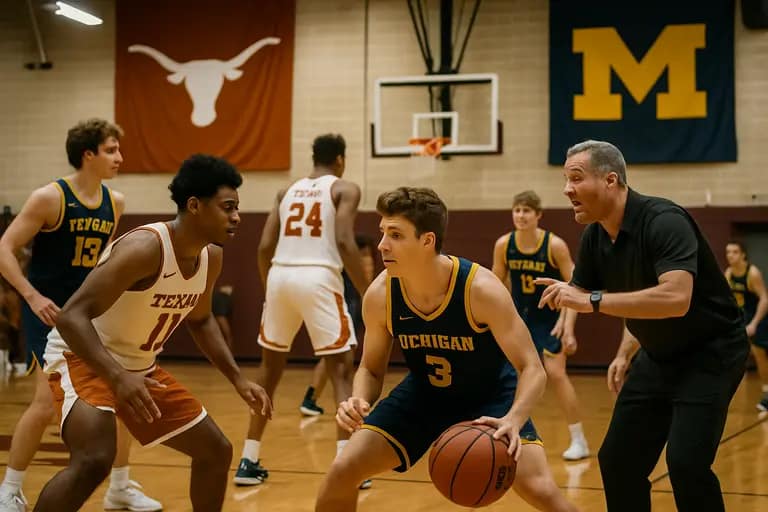
Basketball people in Texas should study this series because rare games create sharper memories. In hoops, a December matchup against a national name or a March neutral-site meeting can carry the same emotional load as these Texas-Michigan football games. The schedule may not repeat every year, so the community stores the result with extra care.
Coaches Know The Value Of A Big Stage
A strategist sees three layers in the Texas Michigan rivalry. First, there is execution: Texas won by one point in 2005, by 19 in 2024, and by 14 in 2025. Second, there is setting: one traditional bowl, one true road test, one Florida bowl. Third, there is memory: each win gave fans a different emotional hook. Coaches in basketball chase the same mix. They want players who can handle a loud gym, a neutral arena, and a late-possession test without losing their habits.
Player development is not only ballhandling, spacing, or shot quality. It is learning to carry community expectation without getting swallowed by it. Texas high school and college basketball programs understand that pressure. A packed gym in a regional final can feel as heavy to a teenager as a national stadium feels to a college veteran. The scale changes; the emotional math stays familiar.
That is why history has coaching value. The 2005 Rose Bowl finish teaches poise. The 2024 Ann Arbor win teaches early control and crowd resistance. The 2025 Citrus Bowl result teaches finishing a season story against a known brand. A Texas basketball coach could use those same themes in a film room without showing a single football snap.
Why Texas Michigan rivalry Still Carries Weight In Austin
The Texas Michigan rivalry carries weight because it lets Longhorn fans compare themselves with another national standard without needing annual hate. Michigan has its own long record of tradition and expectation. Texas has its own statewide pressure and pride. When those two names meet, fans do not treat it as a random non-conference line on a schedule. They treat it as a brand test, a travel test, and a culture test.
For Austin, the story is also about confidence spilling across sports. A football win at Michigan can lift the mood around the whole athletic department. It can sharpen the way fans show up for volleyball, baseball, women’s hoops, men’s hoops, and postseason events across the state. Success in one helmet sport does not guarantee baskets in March, but it can raise the standard for how a fan base prepares, travels, and believes.
Local businesses feel that rhythm too. Big wins fill patios, boost watch-party traffic, sell apparel, and keep sports talk moving through the week. The direct dollars may be hard to separate from the general pulse of Austin, but the cultural effect is clear: Texas fans like events that let them prove scale. They want the airport gate, the road bar, the stadium section, and the Monday lunch table all pointing to the same message.
Three games do not make a traditional rivalry in the old sense. They make something cleaner: a compact series with no wasted chapters. For Texas fans, the record is perfect. For the local sports community, the value is bigger than 3-0. It is a reminder that rare matchups can shape identity, that travel can become a form of home pride, and that the loudest wins often keep echoing long after the scoreboard goes dark.