

Casa Linda basketball received a public jolt on October 30, 2026, when Dallas Wings guard Azzi Fudd, Cash App, and Project Backboard unveiled a renovated court at Casa Linda Park in East Dallas. That date mattered because the work was not only paint, backboards, and a ribbon. It put girls at the center of a public basketball space, and in Texas, that is never a small thing.
I have coached in gyms where girls waited for court time after boys finished, and I have watched neighborhood courts become informal proving grounds for young players who had no travel budget, no private trainer, and no easy ride across town. A park court can tell a child, “You belong here.” That is the cultural weight of this project.
Why Casa Linda basketball Matters In East Dallas
A Local Court With A Public Message
The renovation was unveiled on Friday, October 30, 2026. According to the project details provided, the court has a green base, floral artwork, star motifs, and painted backboards. The sideline phrase, “Every princess needs a court,” tied the space to Fudd’s nickname, “The People’s Princess.” That line may sound playful, but it carried a serious sports message: girls deserve public courts that speak directly to them.
The event also included a ribbon cutting, drills, and a game of knockout with local girls. That detail matters to coaches. Young athletes do not only remember speeches; they remember who rebounded for them, who guarded them, who laughed with them after a missed shot. Fudd’s presence gave the court an opening day, but the real test began after the ceremony, when East Dallas families could treat it as part of their weekly sports rhythm.
Casa Linda basketball As A Girls’ Space
For Casa Linda basketball, the strongest statement was the intent. The court was presented as a place meant to inspire young female athletes. Public basketball courts have long been shared spaces, but shared does not always mean equal. A design that openly welcomes girls can shift who steps onto the court first, who feels safe staying for another game, and who imagines herself as a varsity guard one day.
A Court Built Around Visibility
From Clinic Work To Park Investment
The court did not stand alone as a one-day gesture. The renovation was part of a two-year partnership between Fudd and Cash App during 2025 and 2026. Earlier, on June 2, 2026, that partnership connected with Rae’s Hope in Dallas for an all-girls basketball clinic that included a $35,000 donation and surprise $100 Cash App deposits for each participant. In youth sports, money does not make a player, but it can remove friction: shoes, camp fees, rides, meals, and the small costs that add up for families.
Project Backboard’s role also fit the moment. The nonprofit reports that since its establishment in 2015, it has renovated more than 100 courts across more than 25 U.S. states and internationally, with more than $4 million invested into public parks through its art-court model. In East Dallas, that model gave a neighborhood court a defined identity. It turned a playing surface into a civic marker.
Why Design Counts In Player Development
Coaches talk about reps, spacing, footwork, and shooting form. We should. But young players first need places that pull them toward the game. A court with color, art, clean lines, and working goals can invite repetition. A girl who stops by for ten minutes may stay for thirty. A group that starts with knockout may become a summer workout crew. The Casa Linda basketball renovation gave that process a physical home.
The Participation Gap Behind The Ribbon Cutting
The National Numbers Are A Warning
The celebration in East Dallas came against a hard national backdrop. The Associated Press reported that girls high school basketball participation fell from 451,600 players in 2000 to 356,240 in 2025, a drop of more than 21%, based on National Federation of State High School Associations data AP participation data. That is not a small dip. It is a signal that basketball people need to ask where girls are losing access, interest, or support.
Federal data also shows that access alone does not guarantee equal participation. For the 2013-14 school year, the U.S. Government Accountability Office found boys’ participation was about 43% of male enrollment, while girls’ participation was about 34% of female enrollment, even as public high schools offered about the same number of boys’ and girls’ teams GAO sports participation report. That gap helps explain why a park project can carry meaning beyond one neighborhood.
What The Gap Looks Like Close To Home
Research provided for this story also noted that girls make up nearly half of high school students but receive about 43% of athletic opportunities, with more than one million fewer opportunities than boys. It noted that schools with higher poverty indicators offered fewer girls’ teams than schools with lower poverty indicators. Those numbers are broad, but the lesson is local: opportunity is often decided before a player ever reaches tryouts.
That is why a free public court matters. It does not replace school teams, volunteer coaches, safe transportation, or family support. It does, however, widen the doorway. A girl who cannot afford year-round club fees can still build a handle. A younger sister watching from the sideline can still pick up a ball. A parent can still see basketball as something their daughter is invited to pursue.
Coaching Lessons From A Public Park Court
Culture Starts Before The First Whistle
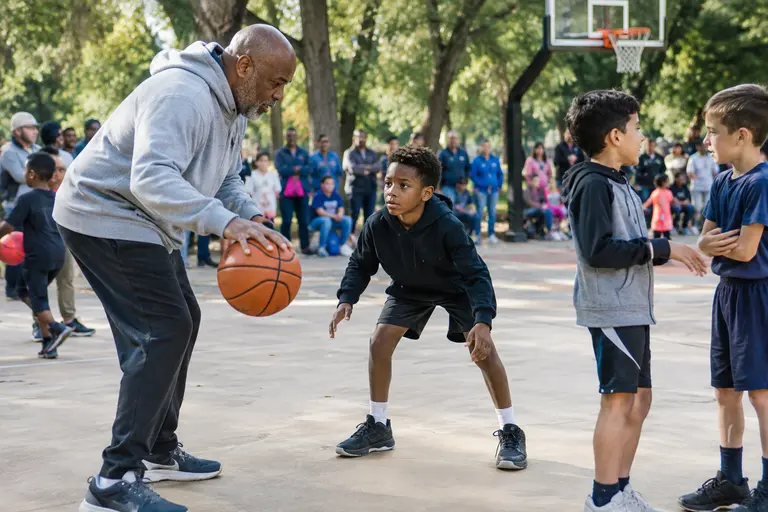
In Texas basketball, we sometimes act as if culture begins at the first practice. It starts earlier. It starts in the driveway, the church gym, the schoolyard, and the park court where older players teach younger ones how to check the ball and call fouls. If girls feel welcome in those places, their skill base grows before a coach ever writes their name on a roster sheet.
The renovated Casa Linda court should be judged not only by how it looked on October 30, 2026, but by what it encourages over time. Does it bring more girls into open play? Does it give middle school players a place to work after school? Does it become a meeting point for families who care about the girls’ game? Those are the questions that matter in a city with real basketball pride.
- For players: the court offers a visible invitation to practice in public, not off to the side.
- For families: it gives East Dallas a neighborhood basketball space tied to girls’ confidence and activity.
- For coaches: it can feed the local skill pipeline before athletes reach organized school ball.
- For the community: it links public art, park use, and youth sports access in one shared place.
What Casa Linda basketball Means For Girls In Dallas
A Texas Basketball Signal
The Casa Linda basketball story is not that one renovated court solved gender inequality. No honest coach would say that. The better reading is that one court gave East Dallas a clear signal: girls’ basketball deserves public beauty, public investment, and public respect.
Azzi Fudd’s role added star power, but the deeper win belongs to the local girls who stepped onto that surface and saw a court built with them in mind. If they return, bring friends, build habits, and claim the space through play, then the project will have done what the best Texas basketball places have always done. It will turn a patch of pavement into a community classroom, one shot at a time.