
Welcome to the world of basketball development. Every dribble, pass, and shot matters. We’ll explore how different player positions grow through training.
Understanding your role is key for success. Whether you’re a guard, wing, or big, it’s important.
This journey isn’t just about drills. Each week brings new challenges and chances to grow. We break it down into steps, or “progressions.”
These progressions are more than physical training. They also include mental agility, teamwork, and strategy. Imagine a guard who reads the game like a chess master, or a big who moves like a dancer. That’s what makes positional training special.
In the next sections, we’ll look at strategies for each position. This way, every player can excel in their role. So, get ready to grow with us!
Guards ball pressure handle finishing vs length and lead a team
Being a guard in basketball is like juggling. If you can’t handle the pressure, everything falls apart. The key for guards is mastering dribbling under pressure. This skill is what makes a guard great, not just good.
On-ball pressure and the art of controlled chaos
When facing on-ball pressure, a guard must embrace the chaos. It’s like a dance, where every move is critical. Quick commands like “Up” for full-court pressure or “Lock” for total disruption are essential.
Kids need clear instructions in the heat of the moment. A guard’s quick response to these commands can change the game.
Handle packages that survive contact and length
Handles must be strong to withstand contact and length. Drills should improve your grip and ball protection. When defenders reach in, your handle should be like a strong wall.
Remember, a blocked shot is okay; a soft finish is not. So, make your moves strong and decisive.
Finishing through size without becoming a blooper reel
Finishing at the rim is tough for many guards. The key is to go straight up strong. Hesitation is a disaster, and fading away is not an option.
Players must attack the basket with confidence, embracing contact. A well-executed layup is priceless, as it scores points.
Leading a team when you’re the smallest voice in the huddle
Leading a team as a smaller guard requires earning respect. It’s not just about being vocal; it’s about leading by example. Your actions speak louder than words.
The ability to command the floor, even when you’re the smallest voice, defines a leader.
Wings movement shooting closeout attacks secondary PnR defensive range
Wings are key in modern basketball, scoring and passing with skill. They must adapt, even when tired and under pressure. Movement shooting is essential here. It’s not just for show; it’s for real games too.
Movement shooting under pressure needs technique and mental strength. Imagine facing a defender as you catch the ball. You must decide to shoot or drive quickly. The choice can change the game.
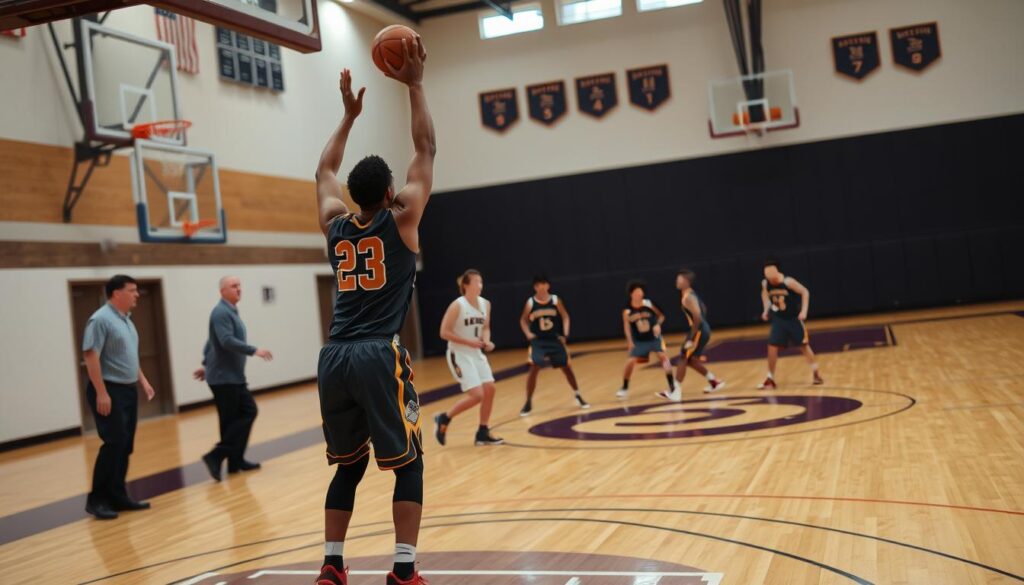
The closeout attack is where wings shine. A good closeout can turn a simple shot into a high-stakes moment. By understanding angles and timing, wings can outsmart defenders and create chances.
Then, there’s secondary pick-and-roll reads. When the main play fails, wings must step up. They can become the key player, slipping into a second ball screen. This skill keeps the game alive and exciting.
Lastly, defensive range is vital in today’s basketball. Can you guard your man and also affect the game two rotations away? It’s not just about effort; it’s about knowing the game’s geometry. Wings who excel here improve their defense and overall game.
Bigs screen angles seals touch passing rim protection without fouling
In today’s basketball, bigs face a unique challenge. They are often overlooked by fans and analysts. Yet, they are key for teams needing help with rebounds and defense.
Being a big man is not just about strength. It’s about mastering skills that can change the game. Here’s how:
Screen Angles That Actually Create Separation
Setting a screen at the right angle is critical. A poorly set screen lets defenders through, ruining your guard’s shot. A slight hip rotation can turn a good screen into a great one. It’s about making contact that’s impressive.
Sealing Deep and the Lost Art of Making Yourself Available
Sealing deep in the post is a fading skill. Legends like Kevin McHale and Charles Barkley dominated the paint. Today’s bigs often settle for shots 15 feet away, missing the chance to dominate.
Touch Passing from the High Post and Short Roll
Touch passing is key for bigs. It shows a player’s ability to catch and pass quickly. It’s a sign of their speed and willingness to pass.
Rim Protection Without Fouling as an Intellectual Exercise
Rim protection is more than just height. It’s about defending without fouling. It requires smart use of arms to block shots without fouling.
For more insights on big men in basketball, check out this article on historic clutch moments. Understanding these elements can improve your game and skills.
Shared skills communication leadership free throw excellence and rebounding
In basketball, some skills are more important than physical ones. Skills like communication, leadership, free throw shooting, and rebounding are key. They help teams work together, no matter their size or strength.
Communication is the first skill. It’s the backbone of a good defense. Without it, even the best players can struggle. A team that talks well can confuse their opponents.
- Defensive Clarity: Players need to say their zones to avoid mistakes.
- Team Cohesion: Calls like “Ball! Gap! Help! Shot!” help the team work together.
- Positioning Awareness: Good communication helps everyone know their role.
Leadership is another important skill. It’s not just for the captain or star player. Anyone can lead by example. A good leader makes sure everyone works hard and supports each other.
- Setting Standards: Everyone should strive for excellence in every practice.
- Encouraging Teammates: A supportive leader can boost the team’s performance.
- Modeling Accountability: Taking responsibility builds trust and respect.
Free throw shooting is also critical. It’s where skill meets strategy. In close games, who makes their free throws can win. But many players don’t practice enough. Here are some tips to improve:
- Track Progress: Keep scores to see who’s improving.
- Practice with Purpose: Practice under game-like pressure to focus better.
- Visualize Success: Mental preparation can help you shoot better.
Rebounding is another skill that anyone can master. It’s not just about jumping high. It’s about wanting the ball more than your opponent. Here’s how to get better at rebounding:
- Anticipate the Shot: Position yourself early to grab the rebound.
- Box Out: Use your body to block your opponent and get the ball.
- Relentless Effort: Always go for the ball; it’s a mindset.

In conclusion, skills like communication, leadership, free throw shooting, and rebounding are essential. They help players contribute to the team, no matter their physical abilities. These skills are the foundation for success in basketball.
Bigs screen angles seals touch passing rim protection without fouling
In today’s fast-paced game, bigs must master the art of screen angles and seals. The difference between a good screen and a great one often comes down to just a few degrees of hip rotation. A screen set at the wrong angle? It’s like inviting the defender to ruin your guard’s day. It’s not just about size; it’s about finesse and timing.
Screen angles that actually create separation
When bigs learn to set screens that create real separation, they become invaluable. A well-placed screen can turn a mediocre play into a highlight reel moment. Think of it as the intellectual heavy lifting of basketball—where a slight adjustment can lead to a game-changing opportunity.
Sealing deep and the lost art of making yourself available
Sealing deep is a skill that has become increasingly rare. Today’s bigs often settle for positions far from the basket, missing out on the chance to dominate inside. Just look at legends like Kevin McHale; they didn’t just post up—they carved out space like they were building a subdivision. This art form is essential for making yourself available where it counts.
Touch passing from the high post and short roll
Touch passing from the high post can separate play-finishers from true play-makers. Can you catch and redirect in one fluid motion? This skill requires not just talent but also an understanding of the game. Recognizing a weak-side cutter before the defense rotates is the hallmark of a big who can read the game.
Rim protection without fouling as an intellectual exercise
Rim protection without fouling is the PhD dissertation of big man development. It’s about verticality—not just jumping straight up, but understanding how to occupy space effectively. A well-timed contest can alter a shot without drawing a whistle. This is the new frontier for bigs, where intellect meets physicality.
For more insights on how to elevate your game, check out the NBA Rookie Ladder. It’s a great resource for understanding the evolving landscape of basketball and the skills needed to thrive.
Strength speed power templates per position with sample sets
In basketball, strength, speed, and power are key to success. Each position needs a special way to improve these skills. Whether you’re a guard, wing, or big, knowing how to use these physical traits can greatly improve your game.
Guards focus on quick changes and stopping fast. It’s not about lifting heavy; it’s about quick movements and stopping smoothly. This skill is vital for fast defense footwork that can leave opponents behind. It’s like a dance, smooth yet powerful.
Guard Templates Built on Change of Pace and Deceleration
Training for guards emphasizes quads and core strength. These areas help players absorb impacts without losing their shot. Some exercises include:
| Exercise | Reps | Sets |
|---|---|---|
| Box Jumps | 10 | 3 |
| Single-Leg Deadlifts | 8 per leg | 3 |
| Deceleration Drills | 10 | 3 |
Wings need to balance side strength with jumping power. They must be strong to slide and quick to jump and finish. It’s a mix of strength and grace.
Wing Templates Balancing Lateral Power with Vertical Explosion
Wings work on rotational strength for shooting. Exercises for wings include:
| Exercise | Reps | Sets |
|---|---|---|
| Medicine Ball Rotational Throws | 12 | 3 |
| Broad Jumps | 8 | 3 |
| Lateral Bounds | 10 per side | 3 |
For bigs, it’s all about core strength and quick starts. A big who can’t hold their ground is useless. They should work on hip extension and loaded carries.
Big Templates Prioritizing Core Stability and First-Step Force
Sample exercises for bigs are:
| Exercise | Reps | Sets |
|---|---|---|
| Farmer’s Walk | 30 seconds | 3 |
| Hip Thrusts | 10 | 3 |
| Single-Leg Squats | 6 per leg | 3 |
These exercises aim to improve performance on the court. The weight room should be exciting, not a chore. Success is shown by how well you play, not just how sore you are.
Skill weeks micro cycles footwork shooting finishing reads
Building basketball skills is like building a pyramid. Each layer must be strong before adding more. A well-planned skill week helps build these layers without overwhelming players. This is key to mastering skills over time.
Designing Micro Cycles That Stack Skills Without Overwhelming
Think of skill weeks as a staircase. Each week, you climb one step, building on what you learned before. This way, players move from not knowing to doing it without thinking in just four to six weeks. It’s based on how our brains work.
Footwork as the Foundation Every Other Skill is Built Upon
Footwork is the base of all basketball skills. Without it, even the best players face challenges. Here’s what to focus on:
- Balance: Essential for maintaining control.
- Pivots: Allow for effective movement and shot creation.
- Jump Stops: Help in transitioning between dribbling and shooting.
- Defensive Slides: Critical for maintaining positioning against opponents.
Every missed shot or turnover often comes from poor footwork. Mastering these basics is essential for more advanced skills.
Shooting Progressions That Build Confidence Before Volume
Many coaches overlook basic shooting drills. Start by practicing form shots near the basket. Gradually increase the distance to ten and then fifteen feet. Success helps the brain learn proper mechanics, avoiding frustration.
Finishing Reads and the Decision Tree Under the Rim
Finishing at the rim involves a decision tree. When catching the ball on the block, players must quickly assess the defender’s position:
- On your back: Use a quick spin move.
- On your hip: A reverse layup might be best.
- Fronting: Consider a lob pass to a teammate.
Each situation requires a different finish. Players with only one move are easy to defend against. It’s about scoring points, not just looking good.
Film checklist by position and three game self scout plan
A film checklist is key to improving player performance. It’s not just about watching highlights. It’s about breaking down every move. This is where video analysis meets the positional development ladder, giving insights to improve your game.
For guards, the checklist should focus on decision-making and how you handle ball pressure. Did you attack the trap or back off? How did you react when the big hedged on the ball screen? These questions help you understand your finishing package under pressure.
Guard film checklist for decision-making and ball pressure response
- Evaluate your response to defensive traps.
- Assess your ball-handling under pressure.
- Analyze your decision-making on the fly.
Wings need to focus on closeout reads and movement efficiency. Did you catch in rhythm, or did you need an awkward gather dribble? Elite players read the closeout before catching the ball.
Wing film checklist for closeout reads and movement efficiency
- Review your catch-and-shoot mechanics.
- Analyze your response to different closeout speeds.
- Evaluate your movement patterns off the ball.
Bigs, you’re not left out. Your checklist should focus on screen setting and defensive positioning. Every ball screen should be reviewed: did you set the angle right, make contact, and roll or pop with intention? Or did you slip early, avoiding the hard conversation?
Big film checklist for screen setting and defensive positioning
- Check your screen angles and effectiveness.
- Evaluate your positioning on defensive rotations.
- Analyze your communication with teammates during screens.
Now, let’s talk about the three-game self-scout plan. This plan reveals patterns from the noise. One game is an anecdote; three games are a trend. Catalog every turnover, defensive breakdown, and missed rotation. The pattern will announce itself like a smoke alarm—impossible to ignore once you’re listening.
The three-game self-scout plan that reveals patterns
- Watch three consecutive games for trends.
- Document key mistakes and successes.
- Identify areas for improvement across games.
Remember, the film doesn’t lie, but it does require literacy. So grab your checklist and get to work. Your journey on the positional development ladder starts with knowing what to look for.
Home session plan for no gym days bands wall and footwork
When the gym is closed, you can get creative. The world outside may be busy, but you don’t have to stop improving. With a wall, a resistance band, and a small space, you can keep up your skills. Welcome to home sessions, where the ladder of development keeps going.
Let’s start with band routines. These are key for keeping strong. A loop band around your knees helps your defense footwork. It works your glute medius, which stops your knees from bending too much during slides. Plus, it strengthens your shoulders, making you less likely to get hurt when you play again.
Then, there’s wall work. It’s like having a passing machine at home. Stand close to a wall and practice passing. The wall catches everything perfectly, without judging you. To make it more challenging, change the distance or speed, or add a pivot before passing.
Now, let’s talk about footwork sequences. You don’t need a big space to improve your agility. In a small area, you can do ladder drills, defensive slides, and jump stops. This is where being creative helps your footwork stand out.
Structuring a thirty-minute home session is key. Begin with five minutes of warm-up to get your blood moving. Then, spend fifteen minutes on skill work, like band routines and wall passes. Next, do five minutes of conditioning to keep your heart rate up. Finish with five minutes of stretching to cool down. Don’t overdo it! Plan for more activities than you think you’ll need. Dead time at home is just a chance for better snacks.
Evaluation rubric ladder by grade and tryout sheets
Evaluating player development needs a clear plan. It’s not just about feelings or notes. A good rubric is key to measuring important basketball skills. It looks at guard skills, wing scoring, and big development.
Setting grade-level goals helps everyone understand expectations. A middle school player who can finish with either hand is special. On the other hand, a varsity player struggling with defense footwork might need to improve.
Tryout sheets are important for fairness. They help you see a player’s true abilities. Use numbers to judge skills, not names.
Talking about playing time should be honest. Use the positional development ladder to guide these conversations. It’s about showing where a player is and how to improve, not criticizing.
Being honest and clear is a gift for coaches. It helps players grow and be accountable.